


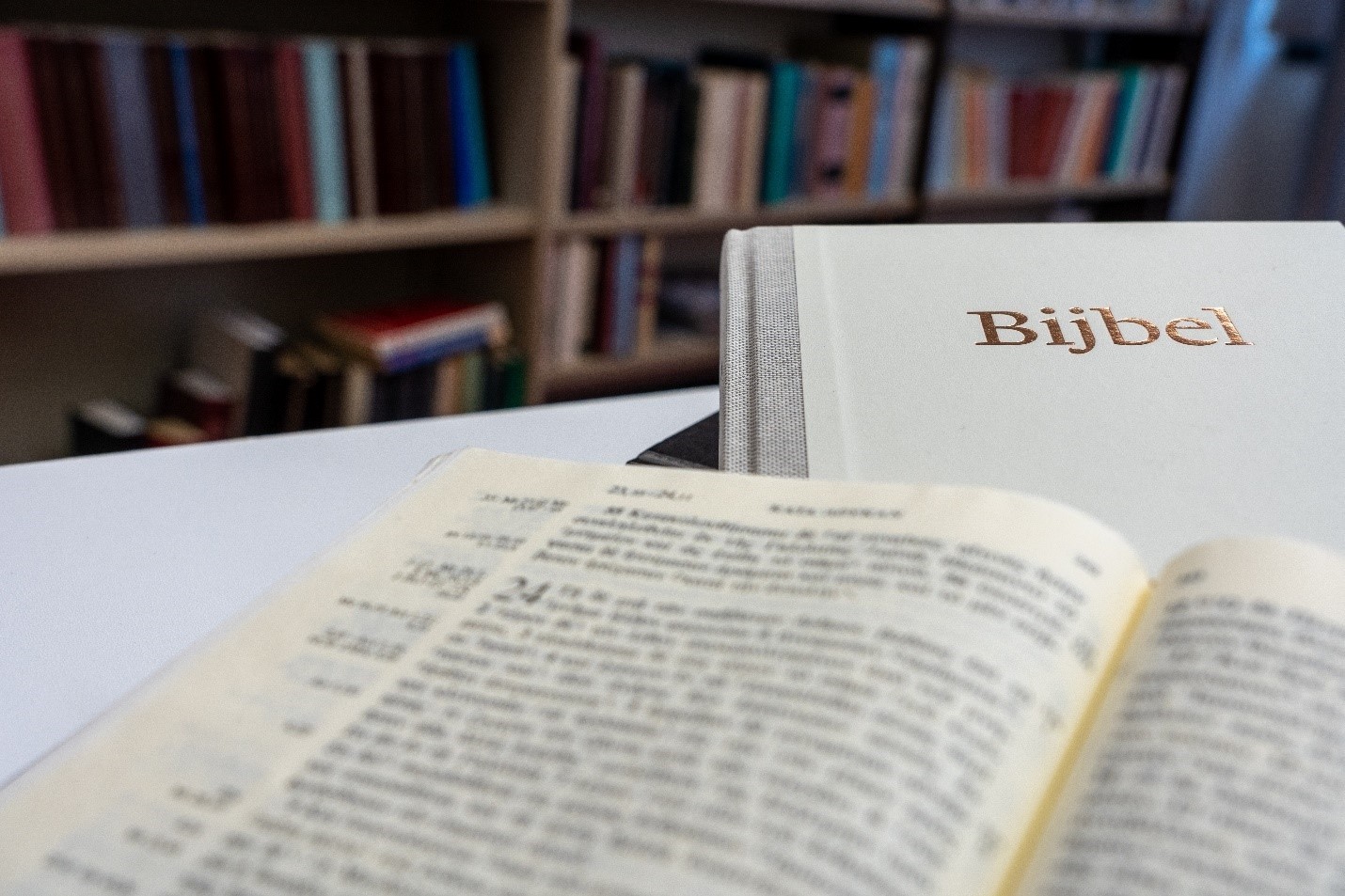
How does Bible translation work? What do you need to keep in mind? You will find out on this page.
On this page, we would like to explain more about how Bible translation works. Use the links below to go directly to the section:
How do Bible translators work? Take a look behind the scenes at the translators of the Dutch-Flemish Bible Society.
To watch this video, you must accept 'Social media and advertising' cookies. Click here to change your cookie settings.
First of all, Bible translators begin by establishing the goals and the working method. After all, every Bible translation has its own characteristics: do you opt for ordinary language with a limited vocabulary? Or will it be a Bible translation in which you can utilize all the richness of the Dutch language?
Next, Bible translators gather all available information. This consists primarily of the source texts, of course. But it also includes dictionaries, commentaries, and other background information about the world of the Bible. And during a revision of a translation, there are also suggestions from readers that can be incorporated. All this information can then be linked together in a computer program (Paratext).
When translating the Bible, we always work in pairs of a source language expert and a Dutch language specialist. We follow an extremely meticulous working method, with room for discussion and careful consideration. This is a process spanning several years. It proceeds roughly according to these steps:

Some words in Hebrew or Greek appear only a few times in the entire Bible. So how do you deal with such unusual words? Discover an example in translator Jaap van Dorp's blog about an angel or a donkey in Deuteronomy.
When translating the Bible, there are sometimes topics that require additional knowledge. That is why we sometimes ask external experts for advice. For example, a Flemish reading group to check whether any strange sentence structures or words have been chosen that have a different meaning in Flanders than in the Netherlands. Or a professor from the liberal Jewish community who reviewed a number of sensitive texts in the Old Testament.
Once the entire Bible has been translated, it is laid out at a Bible printer. Then everything is carefully checked one more time to ensure that everything is truly correct, and the Bible is printed on special thin Bible paper.
To watch this video, you must accept 'Social media and advertising' cookies. Click here to change your cookie settings.
We have listed all kinds of frequently asked questions for you.