


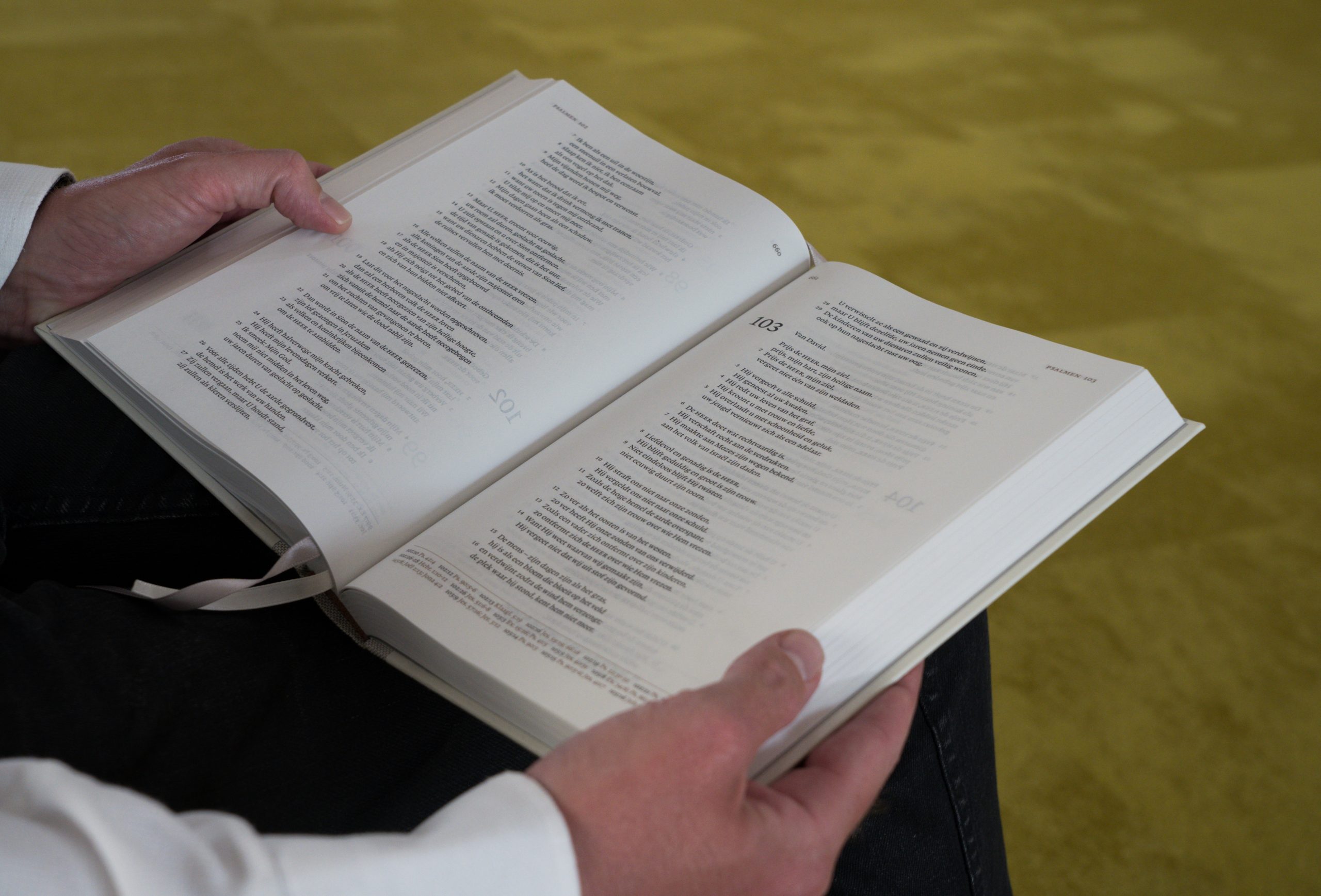
Met Andere Woorden is the free professional journal of the Dutch-Flemish Bible Society. Met Andere Woorden is published twice a year. A subscription is free, but a voluntary donation is requested.
Does it matter to you which Bible translation you read? Do you want to know what goes into translating the Bible? Are you curious about the background to certain translation choices? Then * Met Andere Woorden* is exactly what you need: the magazine that sheds light on current biblical themes from a translation and exegetical perspective. Target audience: pastors, theologians, and other professional Bible users.
The magazine is written in an accessible style, even for those who do not master Greek and Hebrew.
Met Andere Woorden has been the leading professional journal on Bible translation in the Netherlands and Flanders since 1982. Met Andere Woorden is published twice a year. A subscription is free, although a voluntary contribution is requested.
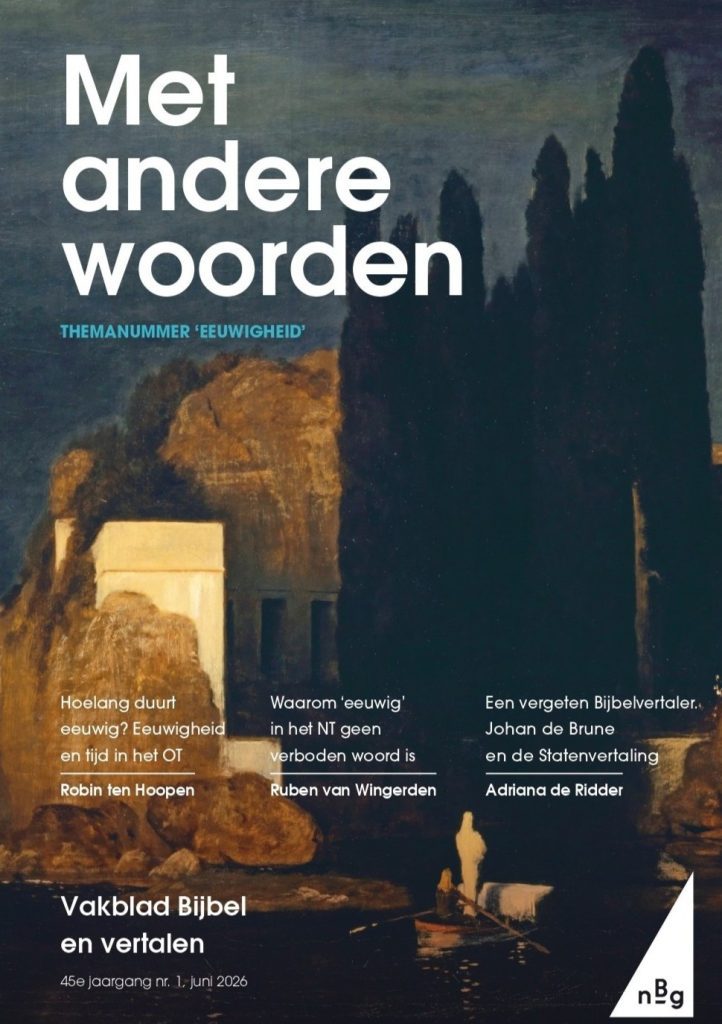
The latest issue appeared in early June and deals with the theme of 'eternity'. Including research articles on the meaning of the Hebrew and Greek terms for this.
The latest issue is a theme issue about eternity.
How long does 'eternal' last in the Bible? With that question in mind, Robin ten Hoopen investigates the meaning of the Hebrew word ʿolām. Ruben van Wingerden investigates this for the Greek word aiōnios . Old discussions surrounding eternal life and eternal punishment have recently flared up due to the books of Reinier Sonneveld and Arnold Huijgen, among others. Therefore, MAW now offers a thorough study of the meaning of the Hebrew and Greek words for eternal or eternity.
Ten Hoopen shows what the Hebrew term ʿolām usually means: 'It concerns a quantitative notion of linear time extending to the furthest conceivable moment within the framework of creation.' In a few other places, including Daniel 12:2-3, this word denotes something that is, in principle, everlasting. All in all, interpreting Old Testament texts using this term requires discernment from the exegete.
Ruben van Wingerden investigated the Greek term aiōnios . Its meaning shifted during the time of the Second Temple to: enduring, permanent, infinite in duration. This resonates in the New Testament texts regarding eternal life and eternal punishment. Therefore, Van Wingerden argues for the retention of the common translation with 'eternal'. For that 'fits well with the use of the Greek aiōnios , which in many biblical texts indicates not only a long duration, but a divine, imperishable reality.'
In his book *The End of Hell* , Reinier Sonneveld argued that aiōnios does not mean 'everlasting', but 'belonging to the coming age'. In this issue of MAW, he engages in a dialogue with Arnold Huijgen. Together with the articles by Ten Hoopen and Van Wingerden, their contributions demonstrate that the biblical texts regarding 'eternity' cannot be conclusively systematized.
Furthermore, in MAW, the two young theologians of the Netherlands, Rozamaryn van Orsel and Nathan Troost-van Diggelen, reflect on the theme of eternity. MAW also contains a contribution on the background of Preekinspiratie and an article by Adriana de Ridder on the importance of the work of the unknown Bible translator Johan de Brune for the Statenvertaling.
The complete archive of the trade journal Met Andere Woorden can be found by article or issue on debijbel.nl.
Articles for Met Andere Woorden are very welcome and can be submitted to the secretariat. All information and guidelines can be found at debijbel.nl.