


The Dutch Bible Society was founded in Amsterdam on June 29, 1814, at the urging of England. For over 200 years now, the NBG has been bringing the Bible closer, both domestically and abroad, for young and old.
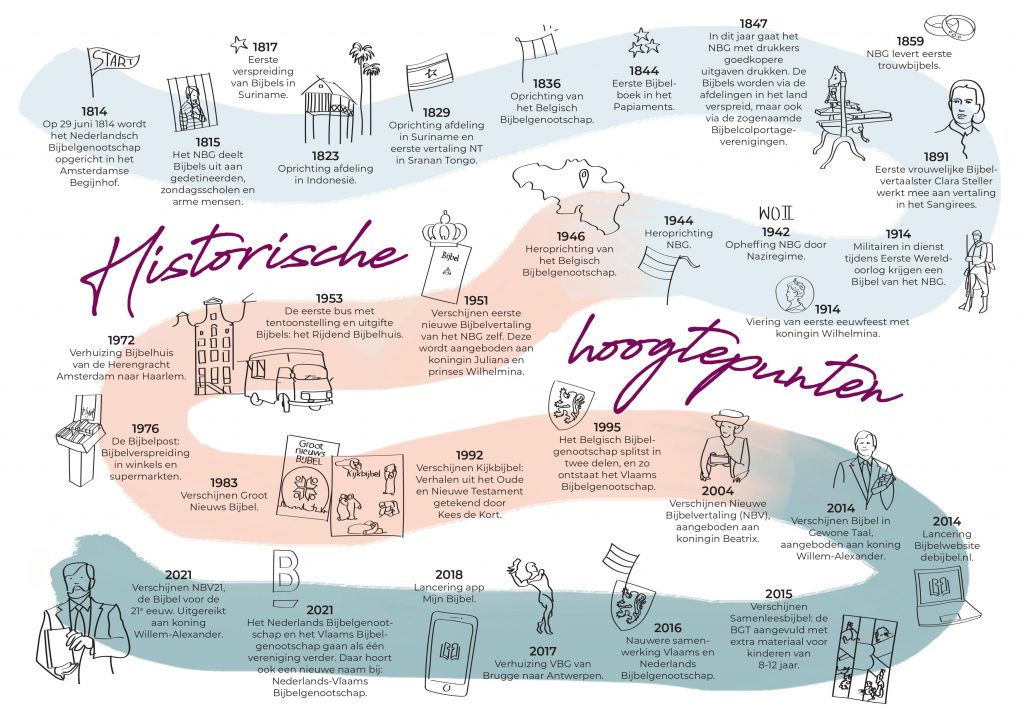
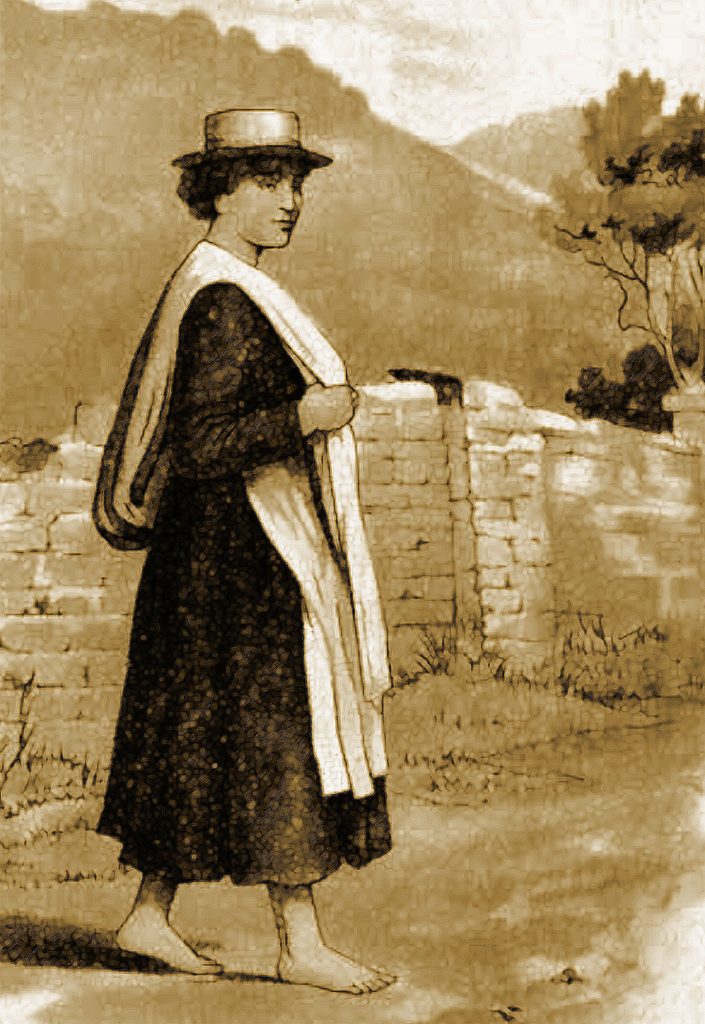
Bible societies were founded in various European countries at that time, the first in England in 1804: the British and Foreign Bible Societies (BFBS). The BFBS had set itself the goal of promoting the distribution of the Bible throughout the world. However, it was only after the fall of Napoleon that this also became possible in the Netherlands and Flanders. Local Bible societies emerged throughout the country, which collaborated in a single Dutch Bible Society from 1815 onwards. From 1815, the board of the Dutch Bible Society also felt responsible for the Bible work in what was then called the 'Southern Netherlands'. From that moment on, the local societies were called branches.
The Netherlands Bible Society purchased Bibles from the major Bible printers who had united in the Bible Company for the publication of the Bible, and placed printing orders with them. Bibles were distributed free of charge to people who could not afford them. In 1847, the Netherlands Bible Society decided to publish Bibles itself as well. It allowed printers to bid, resulting in cheaper editions. The Bibles were distributed not only through the branches but also through the so-called Bible colportage societies.
They visited remote farms with a handcart on which Bibles were displayed.
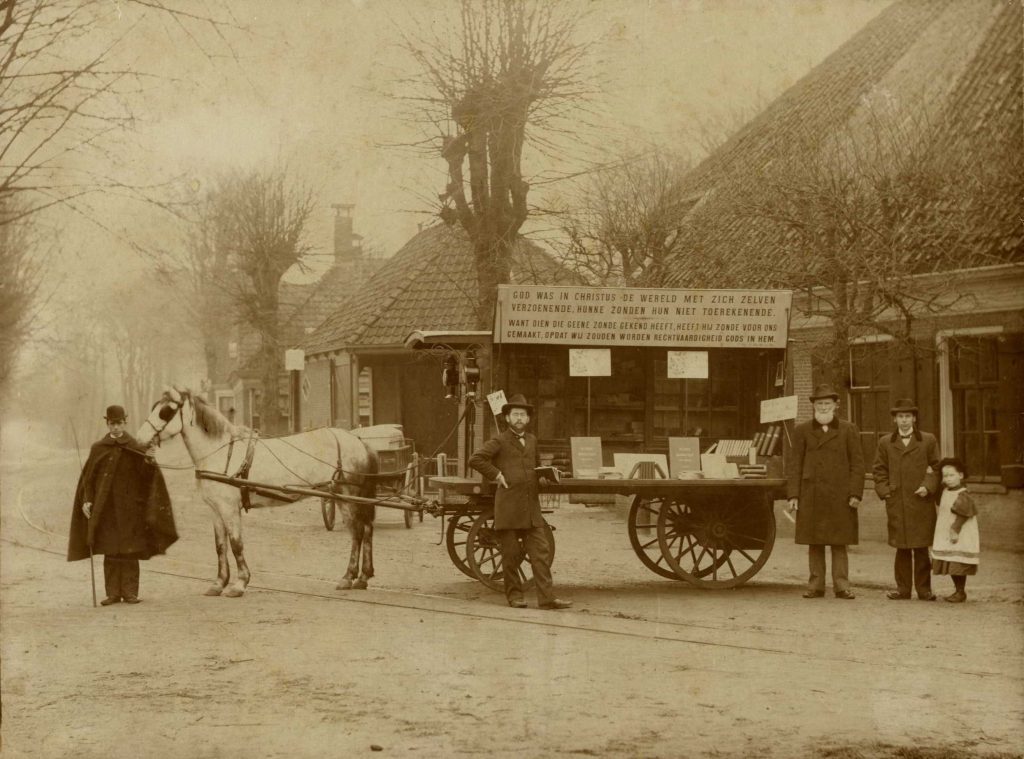
Bible colportage in Heiloo, North Holland in 1896. The 'Bible Wagon' Heiloo. On the far right, the Reformed minister Rev. FJJ Loeff with his little daughter. The inscription on the wagon is taken from the Bible text in 2 Corinthians 5, verses 19 and 21. NBG Archive.
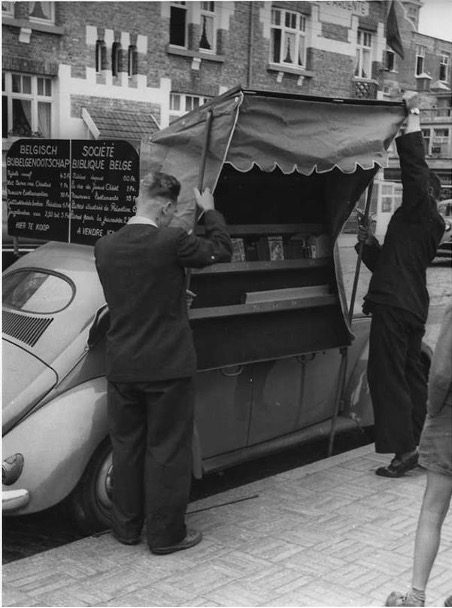
The Belgian Bible Society went door to door.
Soon after its founding, the NBG also began distributing the Bible in what was then the Dutch East Indies. An 18th-century Malay translation was reprinted, and the Bible was translated into Javanese and other Indonesian languages. After the Second World War, translation work for foreign markets passed into the hands of the 'World Federation of Bible Societies'.
The foundation for this umbrella organization, the United Bible Societies (UBS), was laid in the Netherlands. On the occasion of its 125th anniversary in 1939, the Dutch Bible Society invited the Bible Societies to a conference on worldwide cooperation. Five days after the end of the conference, the Second World War began. The cooperation could only get off the ground in 1946, when the UBS was founded in the English conference center of Elfinsward.
There is a lot of hope in the Bible.
Bishop Eivind Berggrav
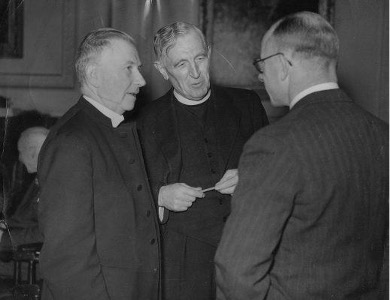
Norwegian Bishop Eivind Berggrav (left), Chairman of the Norwegian Bible Society, speaks with General Secretary John R. Temple (center) of the British Bible Society and another participant in the conference in Elfinsward (photo UBS)
The world lay in ruins. 'There is not much hope in the world,' said Bishop Eivind Berggrav of Norway in Elfinsward, 'but there is a great deal of hope in the Bible.' The UBS now numbers some 160 members and partner organizations. It coordinates worldwide Bible translation and distribution work. The NBG makes a substantial contribution to this.
Bible work was also continued in Flanders during the 20th century. The organizational structure has changed several times. This was related, among other things, to the multilingualism of Belgium and the ecclesiastical constellation, which differs from that in the Netherlands. In 2021, the Flemish and Dutch Bible Societies merged to form the Dutch-Flemish Bible Society.
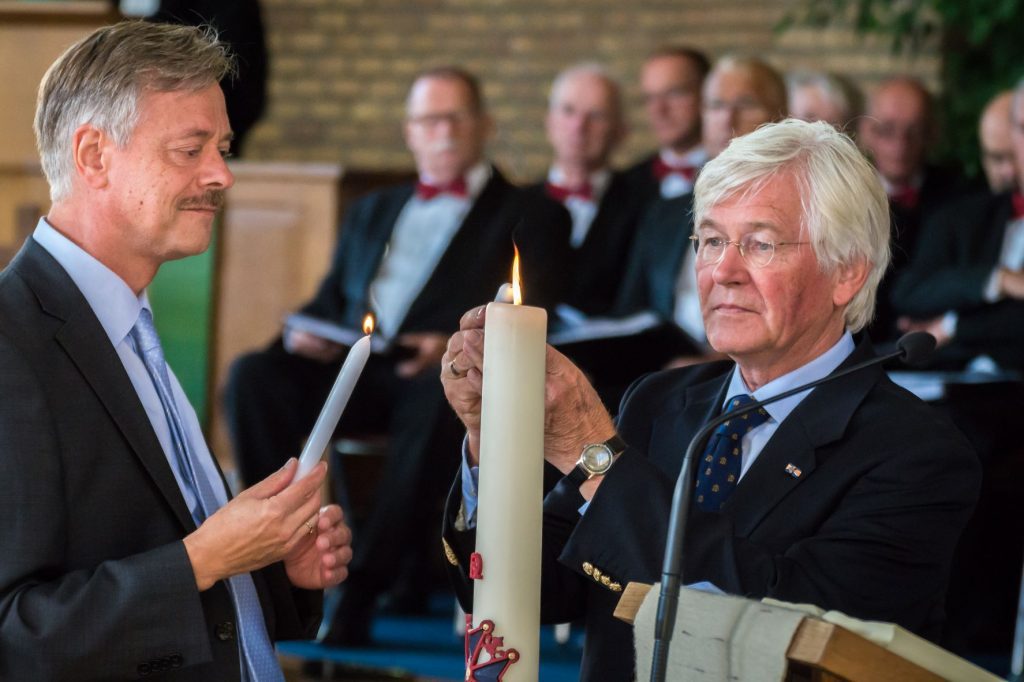
On September 25, 2016, a festive church service was held to celebrate the close collaboration. Jean Bastiaens (then Chairman of the Flemish Advisory Council) and Sybout van der Meer (then Chairman of the Netherlands Bible Society) lit a candle to symbolically reinforce the cooperation.
Even before the First World War, voices were raised calling for a new Dutch translation of the Bible. Although the widely used Statenvertaling had been regularly corrected and adapted to new spelling rules, it was by then three centuries old. In 1927, the NBG began this task. The New Testament was completed in 1937, and the complete Bible appeared in 1951. It was presented to Queen Juliana and Princess Wilhelmina and received much attention, even on television. It became the new standard Bible that was read in many churches and homes.
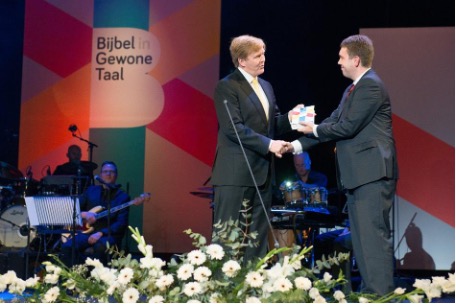
King Willem-Alexander received the first copy from director Rieuwerd Buitenwerf.
New views on Bible translation led the NBG to also translate the Bible 'in colloquial language', everyday Dutch. In 1972, the New Testament appeared: 'Great News for You'. In 1983, the Bible was complete, the 'Great News Bible'.
However, it was deemed necessary to create a third variant: a Bible translation in 'simple Dutch', understandable to everyone. This became the 'Bible in Plain Language'. It was presented to King Willem-Alexander in the jubilee year 2014 – when the NBG celebrated its 200th anniversary. The NBG jubilee was also celebrated with a Bible festival and the exhibition 'Home in the Bible' at the Catharijneconvent Museum.
Meanwhile, the 1951 translation became dated. Therefore, in the 90s, it was decided to produce a new translation that could serve as a central translation for the Netherlands and Flanders. This appeared in 2004 under the name 'New Bible Translation' and was presented to Queen Beatrix. The NBV attracted much interest and many readers; 2 million copies have been sold since its publication.
The promised revision of the NBV – partly with input from the thousands of reader responses that the NBG had called for – is called NBV21 and was published on October 13, 2021.
In 2014, the NBG launched the digital Bible website debijbel.nl , and in 2018 the accompanying app Mijn Bijbel. Since then, the Bible can be read online anytime and anywhere on a computer, smartphone, or tablet. In addition, current blogs and Bible reading plans can be found there, plus a wealth of background information on the Bible.
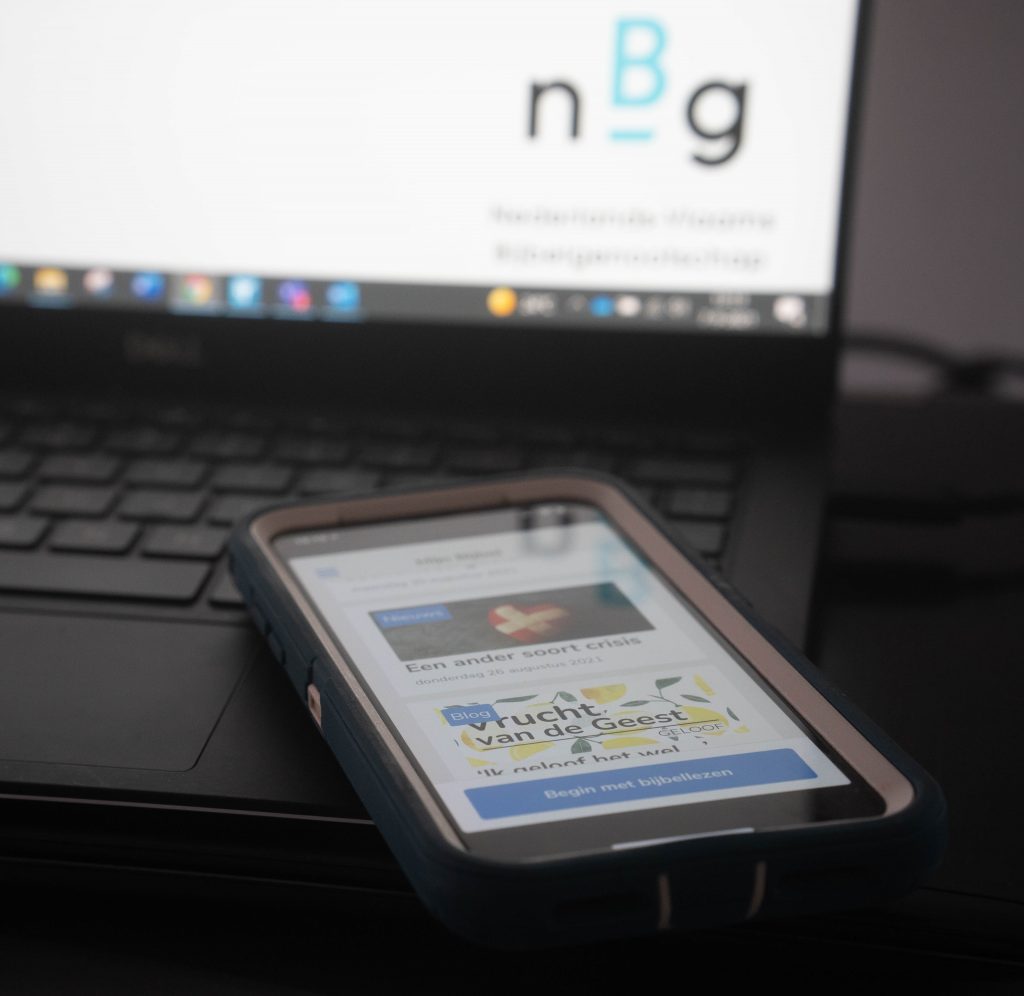
The Bible can be read online anytime and anywhere, on a computer, smartphone, or tablet.
From the very beginning, the NBG also ensured the availability of children's Bibles. In the 1960s, the NBG launched the series of booklets 'What the Bible Tells Us'. In 1964, artist Kees de Kort had won an NBG competition to create Bible illustrations for people with intellectual disabilities. He produced 28 volumes in this series, which were collected in 1992 into the 'Kijkbijbel'. Three million copies of this series have been sold in the Netherlands. The Bible stories with De Kort's illustrations have been translated into approximately 100 languages.
Because the new generation is an important target group for the NBG, new Bible editions are regularly produced for families, children, and young people. In 2008, the Picture Bible was published with illustrations by Marijke ten Cate. It was translated into twelve other languages.
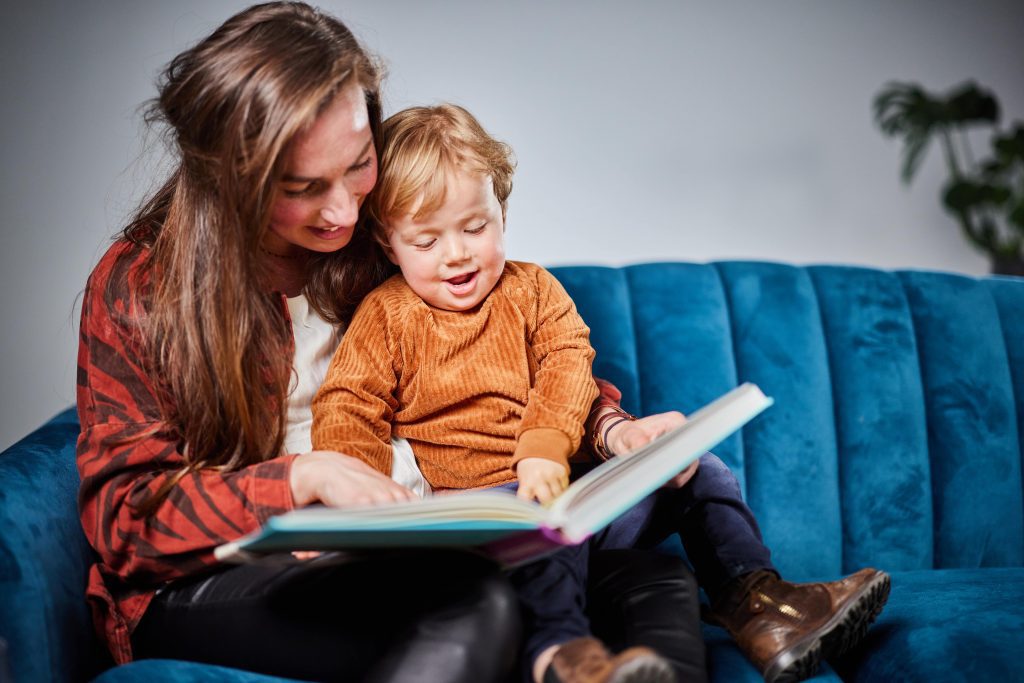
In 2014, the Samenleesbijbel for families with children aged approximately 7-12 was published: the complete Bible in Plain Language, with 'reading routes' through the Bible of increasing difficulty. Editions of this family Bible are also distributed worldwide: in English, Spanish, Portuguese, Arabic, and Chinese.